Beethoven’s jig
Around the Globe, the magazine of Shakespeare’s Globe, Issue 31, Autumn 2005. Heather
Neill welcomes a new user’s guide to the Dream by a versatile practitioner.
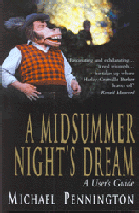
Michael Pennington – actor, writer and practical critic – is the obvious successor
to Harley Granville Barker, the widely acclaimed early 20th-century actor-director-playwright
whose ‘Prefaces to Shakespeare’ are still consulted by modern practitioners. This
book is Pennington’s third analysis of a Shakespeare text as director’s script, following
‘Hamlet’ (1996) and ‘Twelfth Night’ (2000). Pennington knows his ‘Hamlet’, literally,
inside out, having acted in it three times in the roles of Fortinbras, the Ghost
and Claudius as well as Hamlet himself. ‘Twelfth Night’ he directed three times before
embarking on the line-by-line discussion of directorial choices which characterises
these ‘user’s guides’. Now ‘A Midsummer Night’s Dream’ gets similar meticulous treatment
following his popular production of the play at the Open Air Theatre in Regent’s
Park in 2003.
In his engaging introduction Pennington acknowledges that the play under discussion
itself dictates the style and tone of writing and the nature of the material to be
included. His treatment of ‘Hamlet’ is fascinating because writing about it is, as
he puts it himself, “to write about most of life”. ‘Twelfth Night’ he found to be
a comedy with tragic undertones. ‘A Midsummer Night’s Dream’ can be funny, magical
and touching, but there is a suggestion that Pennington would have liked to find
rather more in it, that the mining of the changing emotions of mortals and fairies,
the exploration of poetry and Shakespeare’s choice of verse-structure for different
purposes somehow didn’t lead much beyond itself. And yet ultimately he finds great
affection for the play: “This is also like a jig written by Beethoven, a child’s
picture by Francis Bacon; an early masterpiece by someone who felt growing within
him the power to see further and deeper than any dramatist has done since”. ‘Romeo
and Juliet’ would follow swiftly in 1595. ‘Hamlet was some five years away. Pennington’s
last sentence, concluding the most enjoyable final chapter in which he describes
the building of his own production, ends with an acknowledgement of the ‘Dream’s’
power as theatre: it is “a brush with genius on the move, an open invitation to the
best night out imaginable from the theatre’s great dreamer”.
Solving stage problems leads to some fascinating insights. Here is Puck as down-to-earth
mischievous Robin Goodfellow, “hobgoblin” even, who nevertheless shows a feminine
sensibility, administering “erotic correction” to ungallant Lysander. Theseus and
Hippolyta carry something of their legendary violent past with them, but make terms
“as if Mike Tyson and Emmeline Pankhurst decided to marry”. Demetrius, buttoned-up
and lacking imagination, is liberated into romantic poetry by love-in-idleness. Bottom,
Pennington decides, is both genuine ass and “sunlit William Blake” in his love for
Titania, but (in contrast to other recent directors) feels that their encounter has
an “odd chastity” in it. And as for the fairies – just think of the confusions of
size, capable of affairs with humans but also tiny enough to creep into acorn cups.
The mechanicals and the lovers are perfectly distinguished, their separate journeys
delightfully documented.
Half way through the book is a chapter entitled ‘Interval Music’ and her Pennington
ranges with obvious pleasure through music (Britten, Mendelssohn), painting (Blake,
Fuseli) and film (Max Reinhardt, Woody Allen, Michael Hoffman) inspired by the ‘Dream’.
This is fun and excellent for reference, but it cries out for illustration.
Who will be the user of the guide? Anyone putting on a production, amateur or professional,
would do well at least to dip in for enlightenment about certain scenes and would
probably be hooked. Students may well not read every word (as they might in the case
of the ‘Hamlet’ book), but they could certainly benefit from Pennington ‘s observation
of character and tone as revealed in verse form, especially in the expertly dissected
lovers’ scene in the forest. And anyone with so much as a passing interest in the
‘Dream’ will enjoy ‘Interval Music’ and the final, personal, chapter.
Pennington is well-read, perceptive, a fluent and generous writer, exactly the right
guide for what he describes as “a report from the front on what happens to the play
in the heat of action”. He refers respectfully to Barker, but cannot help noting
his “tight-lipped primness” and calling for a better series for the modern world.
He seems to have embarked on just that.
Return to Books