Brooklyn Daily Eagle, 28th March 2014, Lore Croghan
Michael Pennington will break your heart. That's his job, and he does it magnificently.
Pennington, one of England's foremost classical actors, is a King Lear to grieve
for in Shakespeare's darkest play, which opened Thursday, March 27 at the Theatre
for a New Audience.
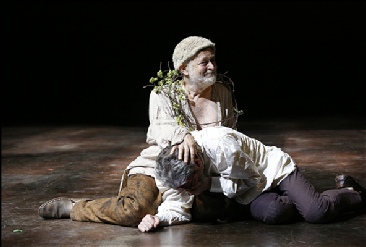
The 40-year acting veteran commands the bare brown stage of the stunning new Downtown
Brooklyn playhouse with a masterful portrayal of the mighty monarch gone mad because
of his folly of putting his fate, and his nation's, in the hands of his feral daughters.
His Lear is harrowing to watch – from his first moment in the spotlight, when he
parcels out his kingdom to the flattery-slinging sibs with an arrogant wave of his
hand over a map, till he breathes his last with dead Cordelia (played by angel-faced
Lilly Englert) in his arms.
This is the 70-year-old Pennington's first time in the role of Lear. It's something
special to have him perform it in Brooklyn, under the direction of Arin Arbus, rather
than in Great Britain.
In the young American woman's Off-Broadway debut year, The New York Times called
her “the most gifted new director to emerge in 2009.”
Pennington, an honorary associate of the Royal Shakespeare Company, has played most
of the Bard's male leads, including Berowne, Coriolanus, Macbeth, Henry V, Richard
II – and Antony in “Antony and Cleopatra” with Kim Cattrall from “Sex and the City.”
His portrayal of Hamlet at the Royal Shakespeare Company in 1980 was voted by British
critics Michael Billington and Benedict Nightingale as one of the 10 best in 50 years
of theater-going.
A two-time Olivier Award nominee, Pennington was the co-founder of the English Shakespeare
Company. He created and performed “Sweet William,” a solo show about Shakespeare,
and solo show “Anton Chekhov.” He has written eight books, among them “Sweet William,
Twenty Thousand Hours with Shakespeare” and “Are You There, Crocodile? Inventing
Anton Chekhov.”
Americans who know their movies better than live theater remember Pennington from
“Star Wars: Return of the Jedi.” He played the commander of the Death Star, Moff
Jerjerrod.
“King Lear” is the second production for Shakespeare-centric TFANA in its new playhouse
at 262 Ashland Place. The theater, which had no home of its own for three decades,
opened its $69 million venue last fall with a widely acclaimed “Midsummer Night's
Dream” directed by “Lion King” creative genius Julie Taymor.
It was a big deal for Taymor, whose reputation had taken a beating because of injuries
to airborne actors in her Broadway rendition of “Spider-Man: Turn Off the Dark.”
Her “Midsummer Night's Dream” – which had flying actors galore – prompted critic
Jonathan Mandell to proclaim on his blog New York Theater, “It is time to love Julie
Taymor again.”
Getting a permanent home for the Bard built in Brooklyn was, in and of itself, a
big deal. The process took TFANA's founding artistic director Jeffrey Horowitz 17
years. It's only fitting that TFANA begin its life in the BAM Cultural District with
big, bold work – and it doesn't get any bigger than “Lear.”
As George Bernard Shaw famously asserted, “No man will ever write a better tragedy
than 'Lear.'”
Fortunately, the other cast members bring their A-game, too, so Pennington's in good
company.
The stage is bare of scenery during the play's three-hours-plus running time.
Just a few choice props are deployed, such as swords, of course, and a boar's head
which is a bloody trophy Lear's retinue of knights picked up while hunting. And when
icily alluring daughter Regan (Bianca Amato) helps her thuggish husband the Duke
of Cornwall (Saxon Palmer) gouge the eyes out of the Earl of Gloucester (Christopher
McCann) as punishment for protecting Lear, a mangled eyeball and a beaker's worth
of blood spatter the stage.
Otherwise, aside from helpful sound effects during Lear's wild night on the storm-struck
heath and a battle scene, it's up to the actors' skilful wielding of Shakespeare's
words to bring Lear's hellish world to life.
Pennington does it to perfection, in moments large and small.
Early on, he shows how unhinged Lear is with a swift switch from volcanic anger to
torrential tears in a face-off with his splendidly wicked daughter Goneril (Rachel
Pickup).
You quake when he curses her to being barren or bearing an evil child so she will
know “How sharper than a serpent's tooth it is/To have a thankless child!”
These are famous Shakespeare verses you're waiting to hear – and Pennington makes
them searing.
So, too, is his piteous mourning of dead Cordelia: “Thou'lt come no more,/ Never,
never, never, never, never.”
For those whose aged fathers once held kingly sway over their clans, there's an added
layer of personal anguish in seeing Lear mired in madness and confusion. After Cordelia
has rescued him and he awakes and doesn't know who she is, it's hard not to sob.
As a side note, it's thrilling to hear other famous verses as the tragedy plays out
– like the rebuke the Duke of Albany (Graham Winton) delivers to Goneril: “Tigers,
not daughters, what have you performed?” And blinded Gloucester's famous lament:
“As flies to wanton boys, are we to the gods:/ They kill us for their sport.”
Favorable mention should also be made of other actors.
Chandler Williams as Gloucester's bastard son Edmund is an oily and engaging foil
to Jacob Fishel as legitimate son Edgar, who feigns lunacy with rubbery-limbed finesse
so he can look after his father. The Earl of Kent (Timothy D. Stickney) and the Fool
(Jake Horowitz) are touching as Lear's faithful companions in extremis.
The Polonsky Shakespeare Center, as TFANA's new venue is called, is a mix of Elizabethan-style
courtyard playhouse and modern black-box theater. Its design by renowned theater
architect Hugh Hardy was inspired by the former Cottesloe Theatre, which is part
of the National Theatre in London.
NY Daily News, 27th March 2014, Joe Ziemowicz
As the addled monarch in King Lear, Michael Pennington wears a fur-collared coat
that’s rich in texture and plummy in tone - just like his voice.
That’s fitting for this spare but powerful production from theatre for a New Audience
that places a value on Shakespeare’s text over tricked-out visuals. Who needs ‘em
when the poetry packs a wallop?
Pennington, who’s 70 and a Brit, can talk the talk. He’s racked up a mile-long list
of classical credits - but he’s rarely in New York. So he makes this appearance really
count.
Pennington is average-sized, but seems to grow twice his height at times. When his
enraged Lear thunders “I will do such things!” it’s as unsettling as the inevitable
0 and very bloody - eye gouging.
But what’s really striking is this two-time Olivier Award nominee’s uncanny depth
of connection with his fellow actors in quieter scenes. Lear’s encounters with his
beloved but cast-away Cordelia, sightless friend Gloucester and bedraggles Edgar,
who’s posing as a crazy beggar, feels more intriguing than ever.
This show’s star isn’t as well known in New York as other Lears - and there have
been a bunch. Frank Langella, Sam Waterston, Kevin Kline and Ian McKellen have all
tackled the Everest-like role. Pennington brings an Everydad quality - and that’s
an asset in this story of daughters and sons versus fathers.
Director Arin Arbus has assembled a fine ensemble. As Cordelia, Lilly Englert brings
a faun-like vulnerability that recalls an early Drew Barrymore. As firstborn sister,
Goneril, Rachel Pickup has a raspy voice that’s barbed with evil. And as second-born
Regan, Bianca Amato’s clipped and exasperated speech and body language suggests a
woman who’s up to her eyeballs in middle-child neglect. She’s Jan Brady in period
clothes.
As the black-hearted bastard Edmund, Chandler Williams proves adept at wordplay and
swordplay. Even better is the open-armed and open-hearted eloquence of Jacob Fishel,
who plays his brother, Edgar. Timothy D Stickney is a sturdy presence as Kent.
Other supporting roles come up a bit shorter - and more mannered. And this production’s
take on the fate of the accordion-playing Fool (Jake Horowitz) is a curious one.
Those are and minor distractions in a potent revival.
The New York Times, 27th March 2014, Ben Brantley
‘King Lear’ has lowered his voice, the better to be heard more clearly. The bluster
quotient has been toned down in Arin Arbus’s thoughtful and affecting interpretation
of this most daunting of tragedies, which opened on Thursday night at the Polonsky
Shakespeare Center in Fort Greene, Brooklyn.
Oh, don’t worry. Thunder still rumbles, swords still clack noisily, and men still
shout in defiance at the unbearable cruelties of the gods. Blood flows copiously
enough to unsettle the squeamish, and the long-awaited fifth-act chorus of “howls”is
appropriately loud and harrowing.
Yet more than any “Lear” I’ve seen (and nobody knows all the “Lears” I’ve seen),
this Theater for a New Audience production gives the impression of talking to - rather
than yelling at - its audience. “Come closer,” it seems to say. “Listen carefully.
You might just find yourself in what’s being said.” No matter that you and your own
kin will never be royals.
For Ms. Arbus is here to remind us just how much “Lear” is a story not only of dynasty
but also of families, with all their mixed-up rivalries and affections. Starting
with the British actor Michael Pennington’s delicate portrait of a paterfamilias
who has never taken time to know his daughters but now expects the world of them,
this “Lear” is less electrifying epic tragedy than absorbing domestic drama.
Some theatergoers may regret the absence of an unconditionally volcanic Lear, who
struts and rants his hours upon the stage in ways that force us into awe-struck submission.
But after decades of watching high-voltage versions - and this year’s contenders
have already included Frank Langella (a power-addicted Lear at the Brooklyn Academy
of Music) and Simon Russell Beale (a Stalinesque Lear at the National Theater in
London) - I welcomed the chance to get to know the old guy under more relaxed circumstances.
By relaxed, I don’t mean casual or accidental. Ms. Arbus has obviously been conscientious
in her reading of this play, and in turning her insights into action. But instead
of imposing big conceptual metaphors (“Lear” in Bosnia! “Lear” in a Soviet dictatorship),
she works from the inside out.
The key here lies in the relationship between the parents and progeny, and among
siblings. Ms. Arbus starts with everyday to build toward the monumental.
Let’s take the opening scene, in which the old King, who has decided to retire, asks
his three daughters to say how much they love him before he rewards them with their
inheritance. When Cordelia (Lilly Englert), his youngest and favorite, refuses to
lay on the flattery, he snaps and orders her banishment.
As Mr. Pennington plays the moment, you can tell that Lear regrets what he’s said
as soon as the words leave his mouth. There’s a softening plea in his glowering eyes
that seem to say: “I didn’t mean it. Get me out of this.”
I don’t know about you, but I’ve certainly experienced family quarrels in which an
ostensibly small slight assumed a long and smothering life of its own. The imp of
the perverse (to borrow from Poe) is never more self-sabotagingly present than in
arguments with loved ones, when feelings run so deep that we can’t even fathom them.
The sorry events that follow here seem personally upsetting because you’re so aware
that none of this would have happened if Lear had thought before he spoke. Mr. Pennington
makes it clear that Lear’s subconscious never stops slapping him in rebuke from that
moment on.
His anger also lights a match to the combustible powder of which his family has always
been made. This production is unusually strong in suggesting the dysfunctional dynamics
that operate among Lear’s daughters. The elder two, Goneril and Regan (Rachel Pickup
and Bianca Amato, both superb), seem steeped in a history of sibling squabbles and
power games. For once, I believed that they, along with Ms. Englert’s youthfully
severe Cordelia, were truly blood-bound.
The same ties of consanguinity are evident in the parallel family of the Earl of
Gloucester (a touchingly goatlike Christopher McCann) and his sons, the scheming
Edmund (Chandler Williams) and the virtuous Edgar (Jacob Fishel). The brothers have
an easygoing rapport when we first meet them, and Edmund’s subsequent perfidy feels
more than ever like an act of unspeakable violation.
That’s what this “Lear” is about: how blindly and instinctively we rely on our families,
and how shocked and solitary we feel when that trust us betrayed. Mr. Pennington’s
King is someone who has assumed unthinkingly that a certain social structure will
always be in place for him.
After his elder daughters’ rejection, he seems truly stunned out of his wits, and
he always appears to be musing, “It wasn’t supposed to happen like this.” Mr. Pennington
punctuates the expected blasts of rage with a quieter, introspective insight that
is even more devastating. As a man who has run a country for years, he knows the
dangers of chaos, and you can sense him trying to find a steady island of calm within
his own disordered wits.
In a variety of shadings, not all the cast - which also includes a serviceably gruff
Timothy D. Stickney as the trusty Duke of Kent - is on Mr. Pennington’s level. And
making Lear’s Fool (a callow Jake Horowitz, the son of the company’s artistic director,
Jeffrey Horowitz) a saucy boy pariah strips an essential depth from his relationship
with the King.
But if some of the performances are one-note, they all combine into a clear, almost
haunting melody. Its motifs are beautifully echoed by the design team, which includes
Riccardo Hernandez (the uncompromising spartan set) and Susan Hilferty (the stately
Edwardian costumes).
Most crucially, Marcus Doshi’s lighting and Michaël Attias’s sound and music design
summon a world in which the senses career between confusion and clarity. A sequence
in which the blinded Gloucester stands alone amid the cacophony of battle is exquisite.
And for the fabled storm on the heath, we shift between muddles darkness and sudden,
startling brightness. In those precious moments of illumination, we are allowed what
feel like flashes of complete understanding, the kind that come to us in dreams and
vanish by morning. Mostly, we’re left groping in the shadows, trying to make sense
of the people we thought we knew best.
NewJerseyNewsroom.com, 28th March 2014, Michael Sommers
Theater for a New Audience and director Arin Arbus offer a stark, supple staging
of “King Lear” with a good company headed by Michael Pennington, who is wonderfully
subtle as the maddened monarch. The elegant simplicity of this rendition is enhanced
by the embrace of the courtyard-style environs of TFANA’s new Polansky Shakespeare
Center, where the production opened on Thursday.
A rusty metal thrust stage is complimented at the rear by a vast rusty metal wall
that eventually leans forward for the scenes on the heath. The Spartan nature of
Riccardo Hernandez’s setting extends to the somber yet smart mid-20th century military
fashions designed by Susan Hilferty. Augmented by the clear shades of Marcus Doshi’s
lighting, these lucid visuals solidly support the players, whose work is finely detailed
and intelligent.
A notable British actor who rarely appears here, Michael Pennington is a compact,
silver-bearded Lear whose relatively low-keyed performance is down to earth and ultimately
touching. Depicting Lear as a predominantly gentle soul given to bursts of temper
that he obviously soon regrets, Pennington rises to the emotional demands of the
storm scenes, when he rages defiance with satisfying fury. Afterwards, spent by his
frenzy, Pennington’s Lear interestingly suggests a moonstruck character out of a
Beckett play, especially when he banters with Christopher McCann’s sightless yet
oddly serene Gloucester.
These two fathers, variously betrayed by their children, provide the palpably beating
hearts at the core of Arbus’ thoughtful interpretation of the tragedy as a family
story. Less of a star vehicle than usual, this “King Lear” is an even-handed group
portrait of different generations in conflict.
Her lips twisting in dissatisfaction, Rachel Pickup portrays Goneril as a poisonous
blond adulterer who cheats on Graham Winton’s mild-mannered Albany with Mark H. Dold’s
snide, sneaky Oswald. Cocking her head and flicking her wrist, Bianca Amato is a
cool and studied Regan whose Lear-like outburst of rage over Gloucester gives off
an erotic heat that is shared by Saxon Palmer’s Cornwall.
In contrast to her mean-girl sisters, who both are obviously drawn to the no-nonsense
Edmund manfully embodied by Chandler Williams, a faintly lisping Lilly Englert appears
to be rather a prig as Cordelia. Also acting on the side of dubious is Jake Horowitz
as a boyish, gimpy Fool. The nicest character among the younger set is a kindly Edgar
who is gracefully played by Jacob Fishel.
The director paces the play briskly with an extended first act – the break occurs
after the blinding scene – and a second act that features a surreal evocation of
the battle sequence that is created by Michael Attias’ squalling music and his discordant
sound design co-credited to Nicholas Pope. The cogency of Arbus’ production in nearly
every respect of its staging, visuals and acting results in a “King Lear” well worth
catching in Brooklyn.
“King Lear” continues through May 4 at the Polansky Shakespeare Center, 262 Ashland
Place, Brooklyn. Call (866) 811-4111 or visit